How to Organize Your Fridge (Bins, Zones and What Goes Where)
A fridge gets messy for a different reason than a cabinet does: food goes in warm, half-used, and in containers that all look alike, and then it hides. The fix is not more containers. It is giving every kind of food a zone it always returns to, and a bin that makes the whole group move as one. When each zone has a job, you can see what you have at a glance, and the back of the fridge stops being a place where leftovers go to expire.
Start by taking stock. Pull everything out, throw away anything past its best or unidentifiable, and wipe the shelves. Sorting is easier when the fridge is empty, and it is the only honest way to see what you actually keep.
Step 1: Give each shelf a zone, by temperature
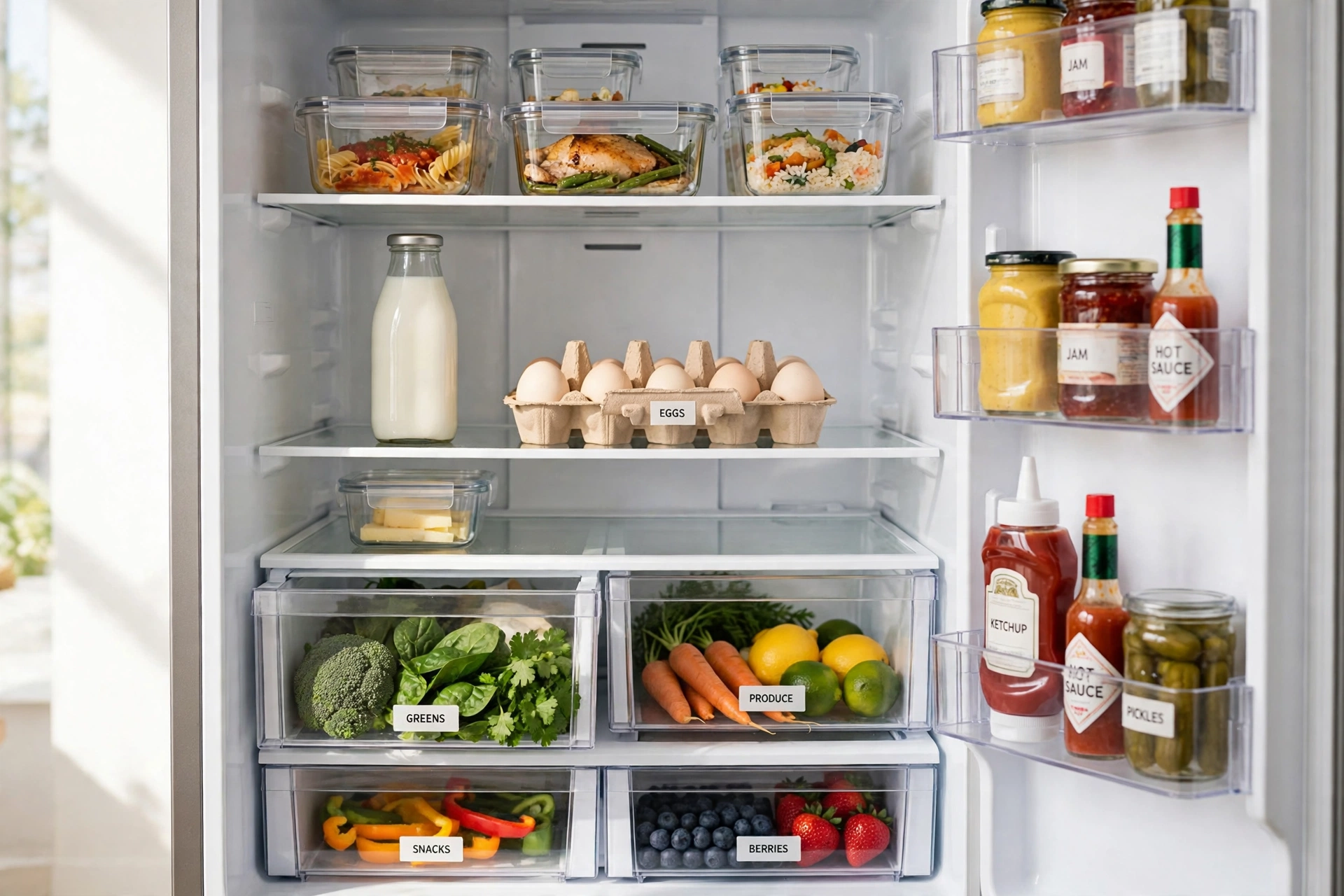
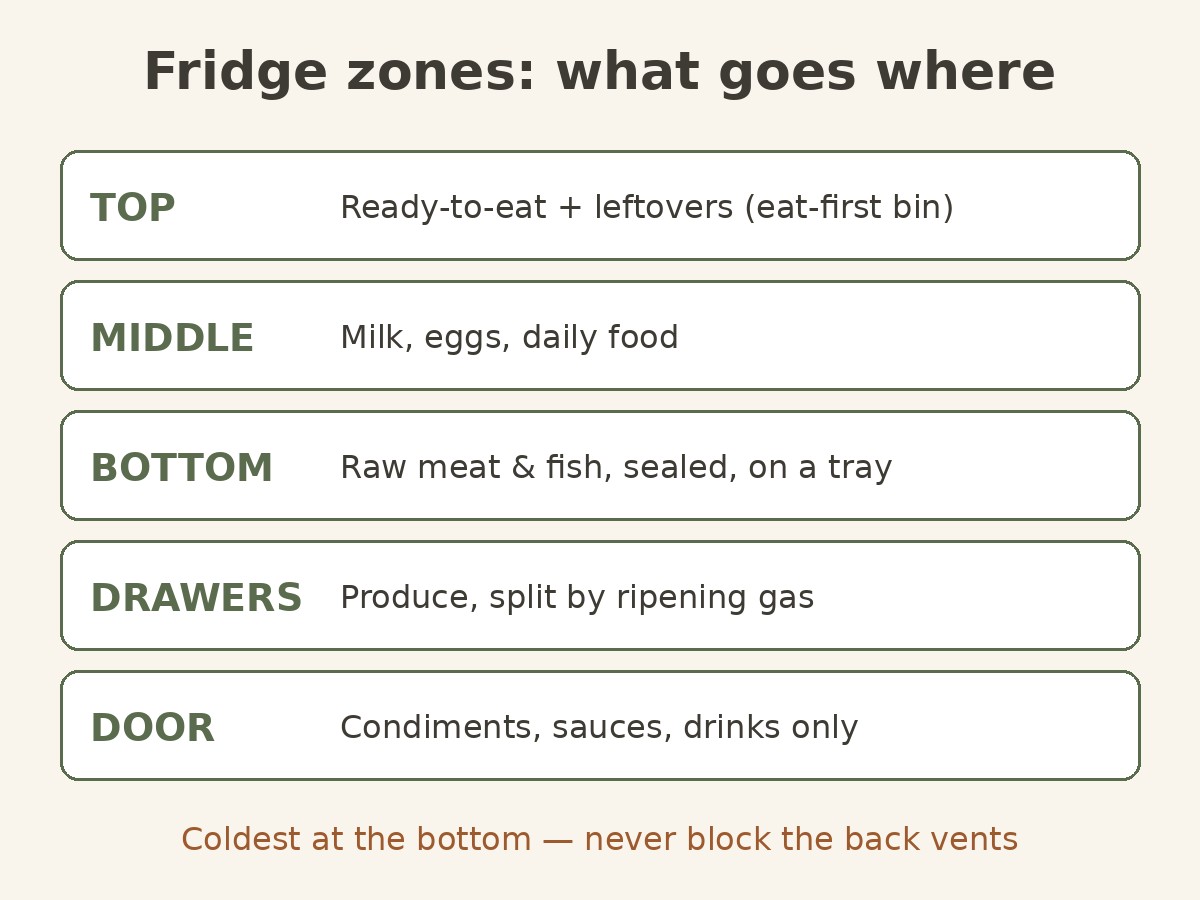
Fridges are not evenly cold, and the zones should follow that. The top shelf is the steadiest, mildest spot: ready-to-eat food lives here — leftovers in clear containers, yoghurt, cheese, cooked food. The middle shelves are the cold, everyday shelves: milk, eggs, and the food you reach for daily. The bottom shelf is the coldest: raw meat and fish, sealed and on a tray so nothing drips onto food below. The drawers are for produce, with humidity doing the work: leafy greens and herbs in the high-humidity drawer, fruit and vegetables that give off gas in the low-humidity one.
The door is the warmest, most changeable spot in the fridge, because it swings open and shut all day. Condiments, sauces, jams, and drinks belong here — never milk or eggs, however convenient the door shelf looks. A bottle that lives in the door should be one that tolerates warming up and cooling down again.
Step 2: Put each group in one bin you can pull out
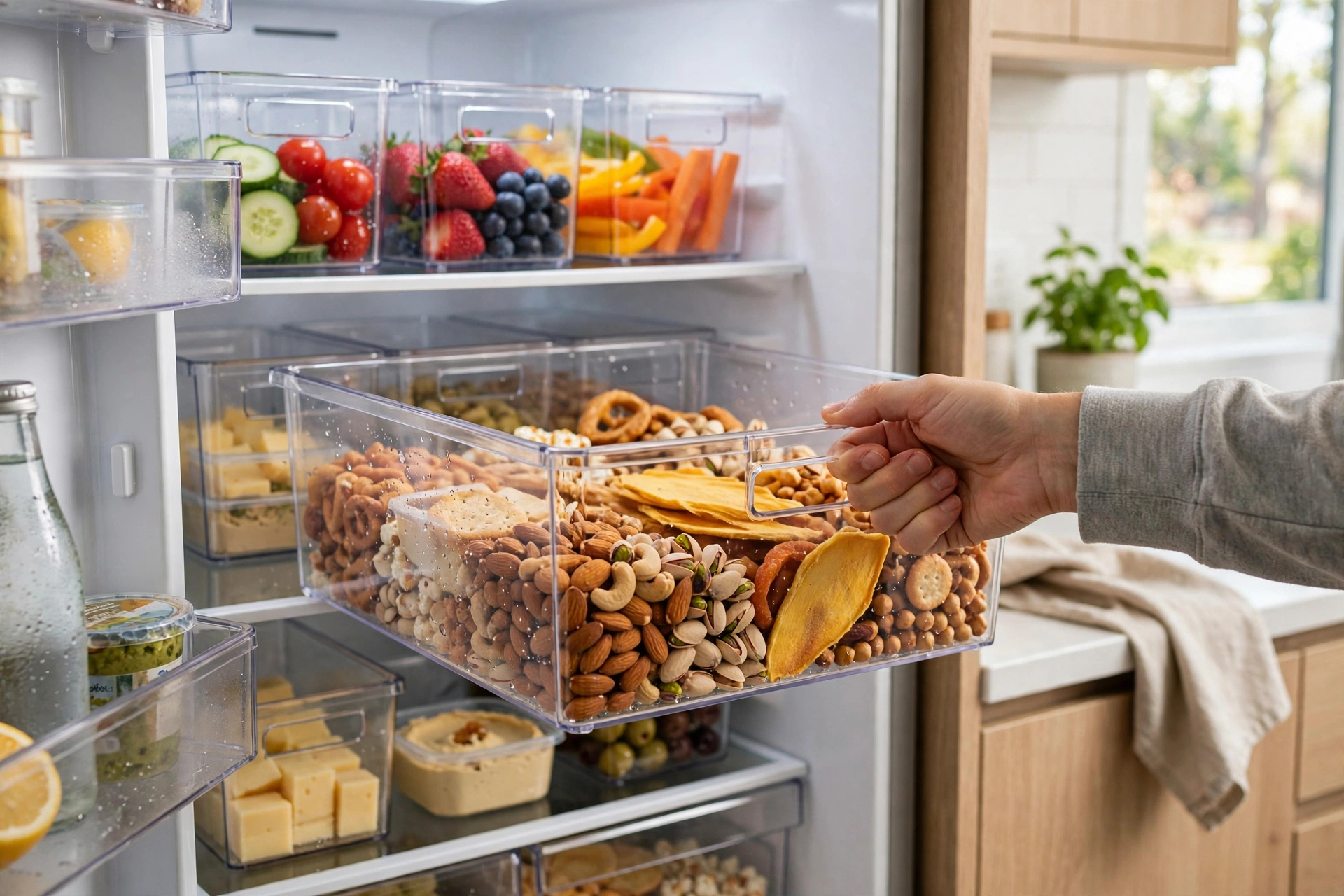
A zone works only if its group moves as one piece. Put leftovers in one clear bin, snacks in another, condiment bottles in a small turntable or a narrow bin on the door shelf. When you want a snack, you pull the snack bin out, choose, and slide it back — instead of moving five jars to reach the one at the back.
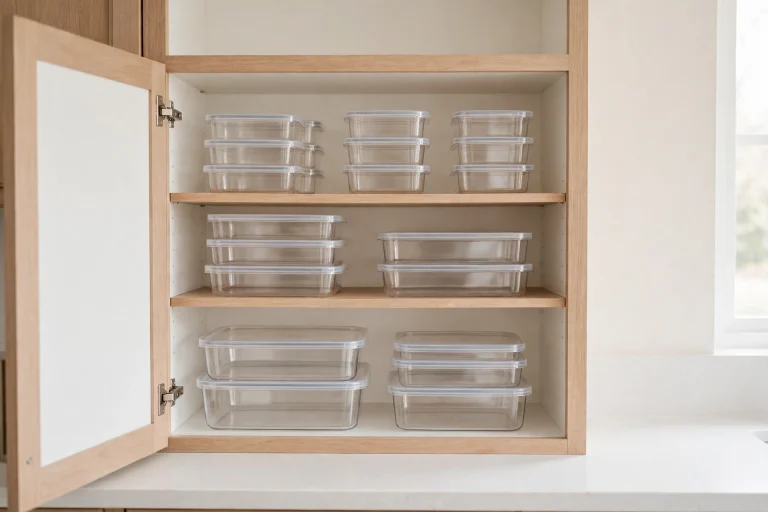
Keep bins clear, not coloured, so you can see what is inside without opening them. Label a bin only if its contents are not obvious, and keep labels short: “Snacks”, “Leftovers”, “Lunch”. A bin that is too deep hides food at the bottom just as surely as a shelf does, so shallow bins beat tall ones for everything except tall bottles.
Step 3: Make leftovers visible, or they will be wasted
Leftovers fail for one reason: they go in opaque containers at the back, and nobody sees them again until they smell. Put leftovers in clear containers, label them with the day they were cooked, and keep them in one front-of-shelf bin on the top shelf — the “eat first” bin. Anything in that bin is the next meal’s starting point, not a mystery to be investigated later.
Once a week, before the shopping trip, eat from the eat-first bin first. That one habit does more for food waste than any new container, because it turns the bin into a rotation system: oldest at the front, newest at the back, nothing left to hide.
Step 4: Keep produce where you will actually use it
Produce rots in drawers for the same reason leftovers rot at the back: it is out of sight. Keep the fruit you snack on at eye level in a clear bin, not buried in a drawer, and keep herbs upright in a jar of water with a loose cover — they last days longer that way and you can see at a glance whether they are still fresh.
In the drawers themselves, do not mix fruit and vegetables that ripen each other. Apples, onions, and tomatoes give off gas that speeds ripening in greens and herbs, so they earn separate drawers. A drawer that holds only one kind of produce stays fresh longer and is easier to empty and wipe.
Step 5: Leave space for air, and a weekly reset
A fridge packed edge to edge cannot stay cold evenly, and a cold spot hidden behind a wall of containers is a spot where food spoils unnoticed. Leave a finger-width of space around bins so cold air moves, and never block the vents at the back with a tall container.
Once a week, take two minutes: pull the eat-first bin forward, toss anything past its date, wipe a shelf if it needs it, and put the new shopping in behind the old. The weekly reset is the same routine that keeps the rest of the kitchen in shape, and it is what stops a freshly organized fridge from sliding back into a pile within a fortnight.
How this fits the rest of the kitchen
The fridge is the cold half of the kitchen’s food system. For the dry half, How to Organize Deep Pantry Shelves (Bins, Risers, Turntables) uses the same bin-and-zone method on pantry shelves. For the routine that keeps all of it in shape, How to Keep a Kitchen Organized: A Weekly 15-Minute Reset Routine covers the weekly pass.
Summary table
| Zone | What lives there | Watch out for |
|---|---|---|
| Top shelf | Ready-to-eat food, leftovers in clear containers | Leftovers only in the eat-first bin, labelled by day |
| Middle shelves | Milk, eggs, daily food | Never in the door — it is too warm and changeable |
| Bottom shelf | Raw meat and fish, sealed, on a tray | Nothing drips onto food below |
| Drawers | Produce, split by ripening gas | Fruit that ripens others stays separate from greens |
| Door | Condiments, sauces, jams, drinks | Warmest spot — no milk, no eggs |
| Airflow | A finger-width around every bin | Never block the back vents |
Frequently asked questions
Where should milk go in the fridge?
On a middle shelf, toward the back, where the temperature stays cold and steady. The door looks convenient, but it warms up every time the fridge opens, and milk spoils faster there.
How long do leftovers last in the fridge?
Most cooked leftovers are good for three to four days. Label the container with the cooking day, keep it in the eat-first bin, and plan to eat it within that window — if it is still there on day five, it goes.
Should fruit and vegetables share a drawer?
Only if neither gives off much ripening gas. In practice, keep gas-giving fruit (apples, tomatoes, onions) apart from leafy greens and herbs, which spoil faster when exposed to it.
Do I need special containers to organize a fridge?
No — clear bins you already own work, as long as each group has one bin and the bin is shallow enough to see into. Clear beats coloured, because you can see what is inside without pulling it out.
Why does food at the back of the fridge go bad first?
Because it is out of sight, not because the back is warmer — in fact the back is usually colder. The fix is visibility: clear bins, an eat-first bin at the front, and a weekly check before shopping.
Shop This Guide’s List
Prefer to shop it all in one place? Every product in this guide is collected in our Benable list: Fridge Organization Essentials for a Calm, Easy-to-Use Fridge — tap any item to see it at the store.

One Comment