How to Organize Spices So You Can Actually Find the One You Need
To organize spices so you can actually find the one you need, group them by how often you cook with them, keep every jar the same size, and store them in one place where the labels are visible at a glance. Alphabetical order looks tidy and fails in real kitchens, because the paprika you use three times a week ends up buried next to a spice you bought once for a single recipe. Organize by use first, and let alphabet be the tie-breaker inside each group, not the whole system.
Spices are the smallest items in the kitchen and the easiest to lose track of. They multiply quietly — a new jar for every new recipe, a half-used packet pushed to the back, two open jars of the same thing because you forgot the first one. The fix is not more jars. It is fewer jars, in one system, with a rule for what leaves the collection.
Step 1: Count what you actually have
Take every spice out of every spot it lives — the cabinet, the drawer, the top of the fridge, the packet folded over in the pantry — and put them all in one place. Count them honestly. Most kitchens hold between 20 and 40, and at least a quarter of them are duplicates, empty, or past their best.
Check each one three ways: smell it (if it smells of almost nothing, it is done), check the date if there is one, and check whether you have two of the same thing. Combine duplicates into one jar. Throw out anything stale, damp, or unlabelled and unidentifiable. What remains is your real collection, and it is almost always smaller than you feared. If you cook with fewer than a dozen spices regularly, say so to yourself — the system below still works, it just takes one small shelf instead of a whole cabinet.
This count also tells you which storage option fits. Under about 15 jars, almost any single spot works. Over 25, you need a dedicated drawer, cabinet shelf, or rack, because a system spread across two spots is a system you will stop maintaining.
Step 2: Sort by use, then by cuisine
Divide what is left into three groups:
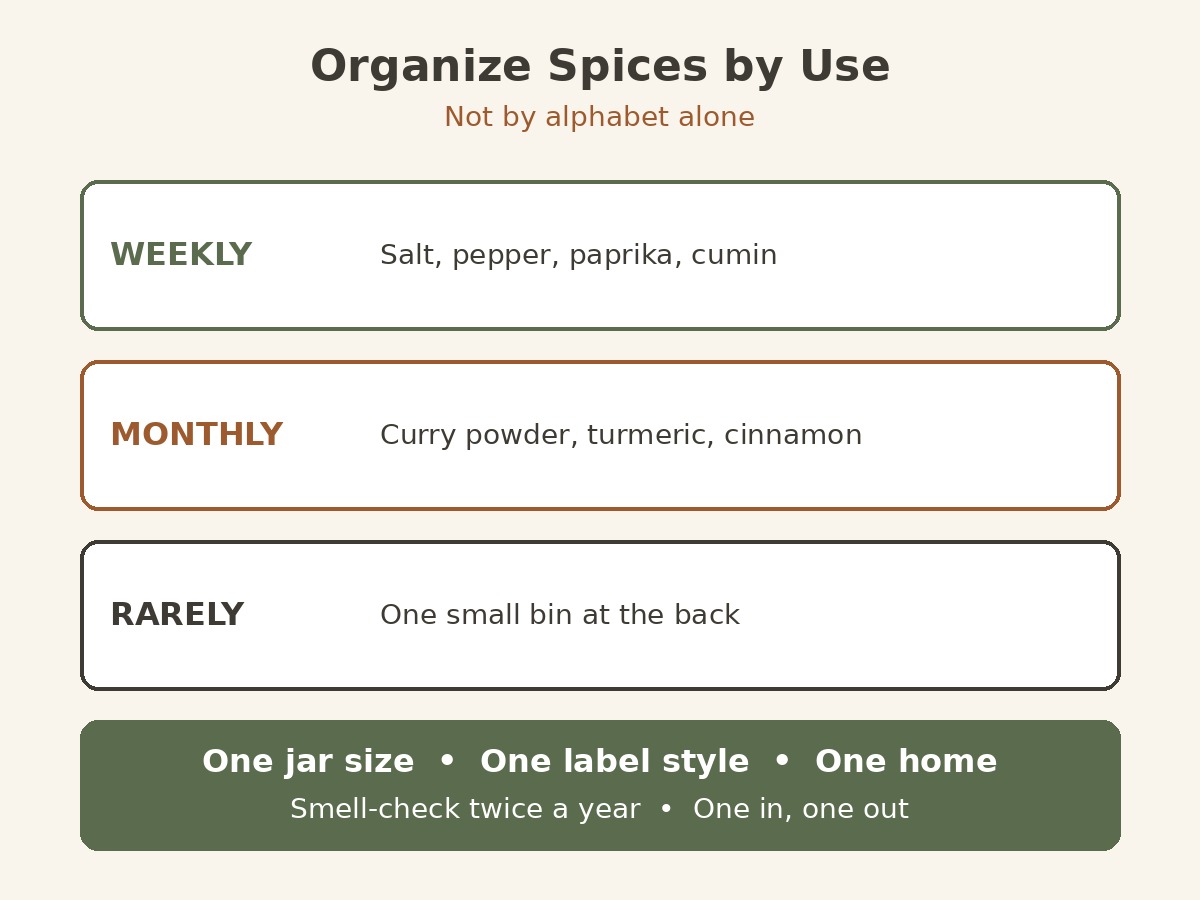
- Every week. Salt, black pepper, and the five to eight spices that appear in your regular cooking — for most households, paprika, cumin, garlic powder, oregano, chilli flakes, and one or two more. These live at the front, at hand height, wherever your system sits.
- Every month. The spices for dishes you cook a few times a month: curry powder, turmeric, cinnamon, thyme, rosemary, bay leaves. These sit behind or below the weekly group, still in the same place, still labelled.
- Rarely. The single-recipe spices and the seasonal ones: whole cloves, star anise, the blend bought for one holiday dish. These go in one small labelled bin at the back, so they do not colonise the front row.
Inside each group, order alphabetically or by cuisine — whichever you will actually remember. Cuisine grouping works well if you cook distinct styles (one row for Mediterranean, one for curries, one for baking spices). Alphabet works if you think in names. Either is fine; mixing the two without a rule is what causes the hunting. Pick one order per group and keep it.
If a spice has not been used in a year, it does not need a better jar. It needs to leave. Keeping it “just in case” is how a 20-jar system quietly becomes a 40-jar one.
Step 3: One jar size, one label style
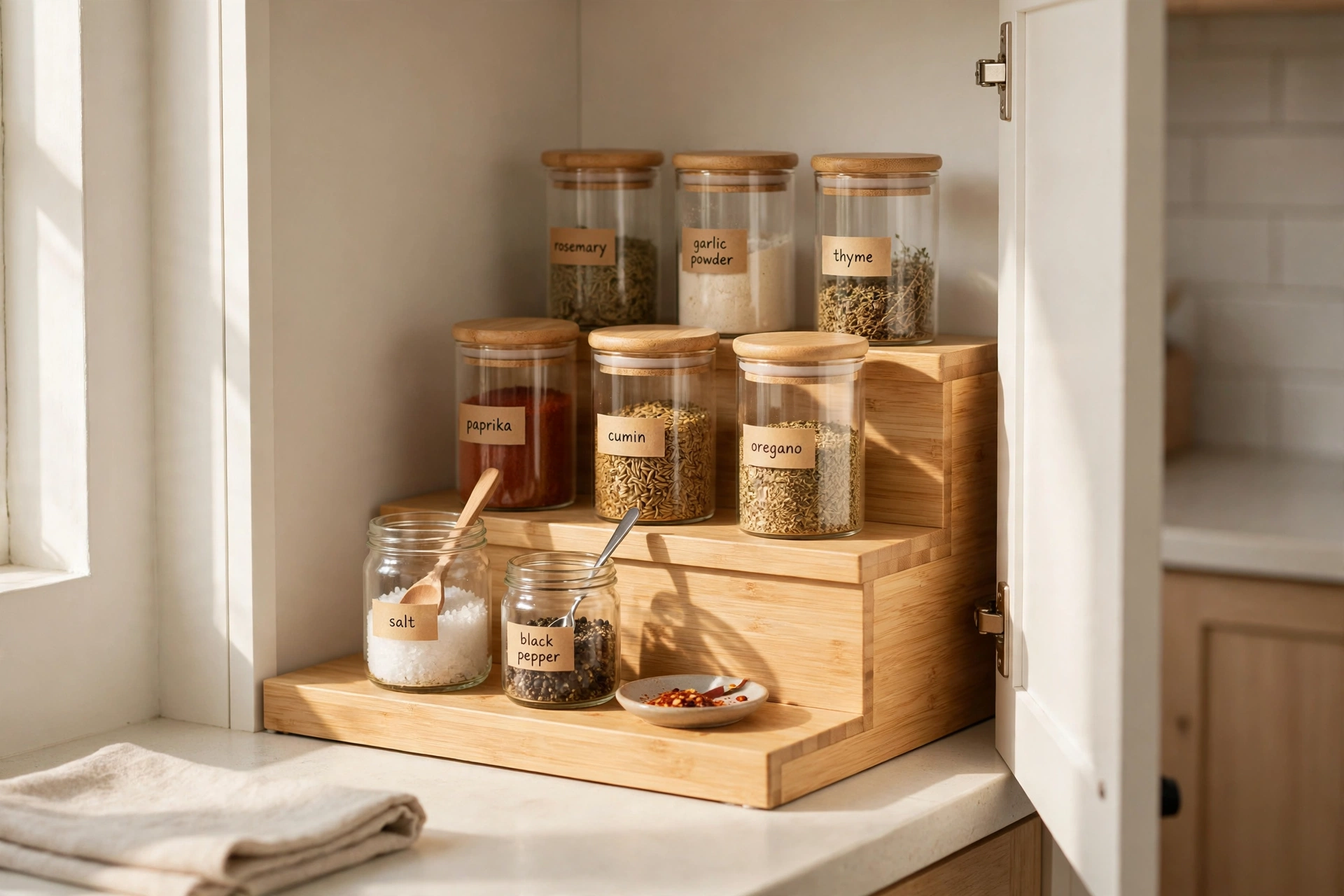
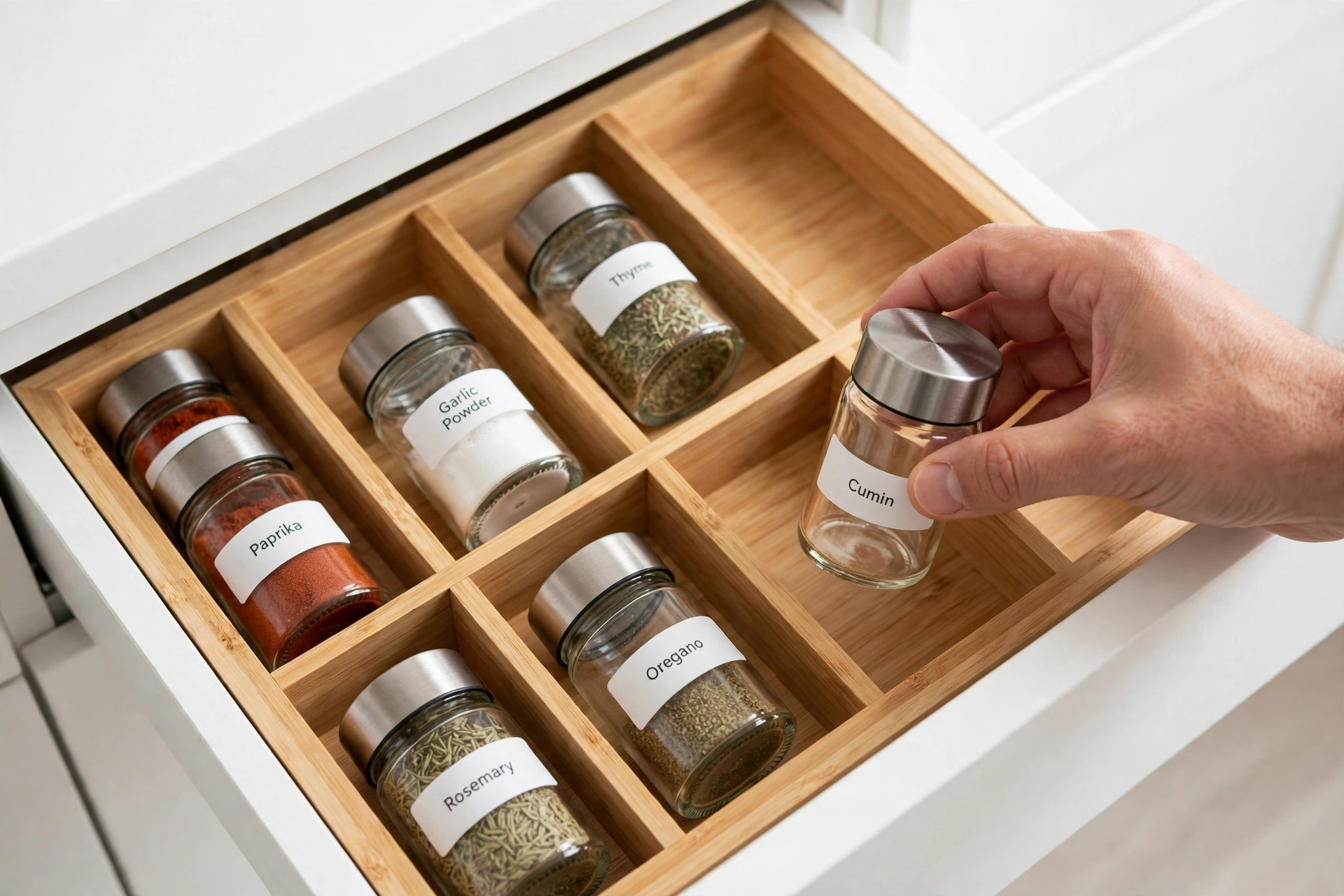
Different jar shapes are the hidden reason spice systems collapse. Tall jars hide short ones, round jars waste the corners of a drawer, and packets of different sizes cannot be lined up at all. Move your spices into jars of one size — small glass jars with a tight lid are enough — and label them all the same way: name on the front (or the lid, if they lie flat in a drawer), in the same handwriting or print style.
Do not decant everything at once if that feels like a big job. Start with the weekly group, which is the one you handle daily, and move the rest over as jars empty. The rule that matters is that no spice lives in its shop packet long-term: packets tear, spill, and cannot be stacked or lined up, so they always end up at the back.
Label with the name only, not the date you bought it — a date label on every jar is a system nobody maintains. Instead, write the month and year on the bottom of the jar when you refill it, so freshness checks (Step 5) take seconds.
Step 4: Pick one home — drawer, cabinet, or rack
Spices need one home, close to where you cook, away from heat and steam. The stove itself is the worst spot: heat and steam above a hob fade flavour fastest. Choose the option that fits your kitchen:
- A drawer. Best for small kitchens, because a drawer insert holds jars flat with labels facing up and uses space that is otherwise awkward. Keep the weekly group in the front rows of the drawer.
- A cabinet shelf with a riser. Best when you have a spare shelf near the stove. A stepped riser lifts the back row into view, so every label is visible without moving jars. This pairs well with the pantry method in our guide to organizing a small pantry step by step.
- A door rack or wall rack. Best when cabinet and drawer space is already spoken for. Inside a pantry or cabinet door, a rack keeps jars visible and frees a shelf entirely. On the wall, keep it away from the hob and out of direct sunlight.
Whatever you choose, the weekly group goes where your hand lands first, and nothing else — no oils, no sauces, no packets — shares the spice spot. Shared spots are where spices get pushed aside.
Step 5: Keep them fresh, and keep the system small
Ground spices lose strength after about six months to a year; whole spices last longer, often two to three years. You do not need a spreadsheet. Twice a year — when you do a bigger kitchen tidy, or when the weekly reset routine runs — smell the weekly group and check the refill dates on the bottoms of the jars. Anything flat-smelling gets replaced, not topped up on top of stale spice.
The maintenance rule is one in, one out. A new spice joins only when you have a dish in mind that needs it, and it takes the place of something that leaves — the stale jar, the duplicate, the single-recipe spice you never used again. Without that rule, every new recipe adds a jar and the system quietly outgrows its home again.
What not to do
- Do not store spices above the hob or next to the oven. Heat is the fastest way to kill flavour.
- Do not keep spices in clear jars in direct sunlight. Light fades them almost as fast as heat does.
- Do not buy a matching set of 30 jars before counting what you own. Count first, then buy only the jars the real collection needs.
- Do not alphabetize the whole collection and call it organized. Alphabet helps you find a name; use-first grouping helps you cook, which is the point.
Summary table
| Step | What to do | Result |
|---|---|---|
| 1. Count | Gather every spice from every spot, combine duplicates, discard stale ones | Your real collection, not your imagined one |
| 2. Sort by use | Weekly / monthly / rarely, then alphabetical or by cuisine inside each group | The spices you cook with are always at hand |
| 3. One jar, one label | Same-size jars, same label style, name where you can see it | No jar hides another |
| 4. One home | Drawer, cabinet riser, or door/wall rack — near the stove, away from heat | One place to look, every time |
| 5. Stay fresh | Smell-check twice a year, one in one out | The system stays the size it started |
Frequently asked questions
Should spices be organized alphabetically or by cuisine?
By use first, then either. Put the spices you cook with every week at the front, and order each use-group alphabetically or by cuisine — whichever you will remember. Alphabet alone buries your most-used spices among ones you rarely touch.
How long do spices last?
Ground spices stay strong for roughly six months to a year; whole spices last longer, often two to three years. Smell is the reliable test: if a spice smells faint, it will taste faint too, and it is time to replace it.
Is a spice drawer or a spice rack better?
A drawer is best in a small kitchen because it uses awkward space well and keeps jars out of light. A rack is best when drawer and cabinet space are already full. Either works if all the spices live in that one place and the labels are visible.
Do spices need to be in matching jars?
Matching size matters more than matching style. Jars of one size line up, stack, and fit a drawer insert or riser; mixed sizes hide each other and waste space. Start with the weekly group if decanting everything at once feels like too much.
Where should spices not be stored?
Not above the hob, not beside the oven, and not in direct sunlight. Heat, steam, and light all fade flavour. A drawer, a cabinet shelf away from the hob, or a door rack in a cool spot all work better.
Your next step
Start with the count: gather every spice into one place tonight and see what you actually own. The rest of the system — sorting by use, one jar size, one home — takes less than an hour once the duplicates and stale jars are gone. For the wider kitchen, our guide to organizing a kitchen by zones explains where the spice spot sits in the cooking zone, and our guide to organizing deep pantry shelves covers the bins and risers that work when the spice collection shares a pantry shelf.
Shop This Guide’s List
Prefer to shop it all in one place? Every product in this guide is collected in our Benable list: Spice Organization Essentials for a Small Kitchen Where Every Jar Is Easy to Find — tap any item to see it at the store.