How to Organize Kitchen Drawers by Task, Not by Item
Most kitchen drawers fail for one simple reason: they are sorted by what things are, not by what you do with them. All the spoons together, all the knives together, all the gadgets together — and then every meal sends you to three different drawers, digging past things you do not need to find the one thing you do.
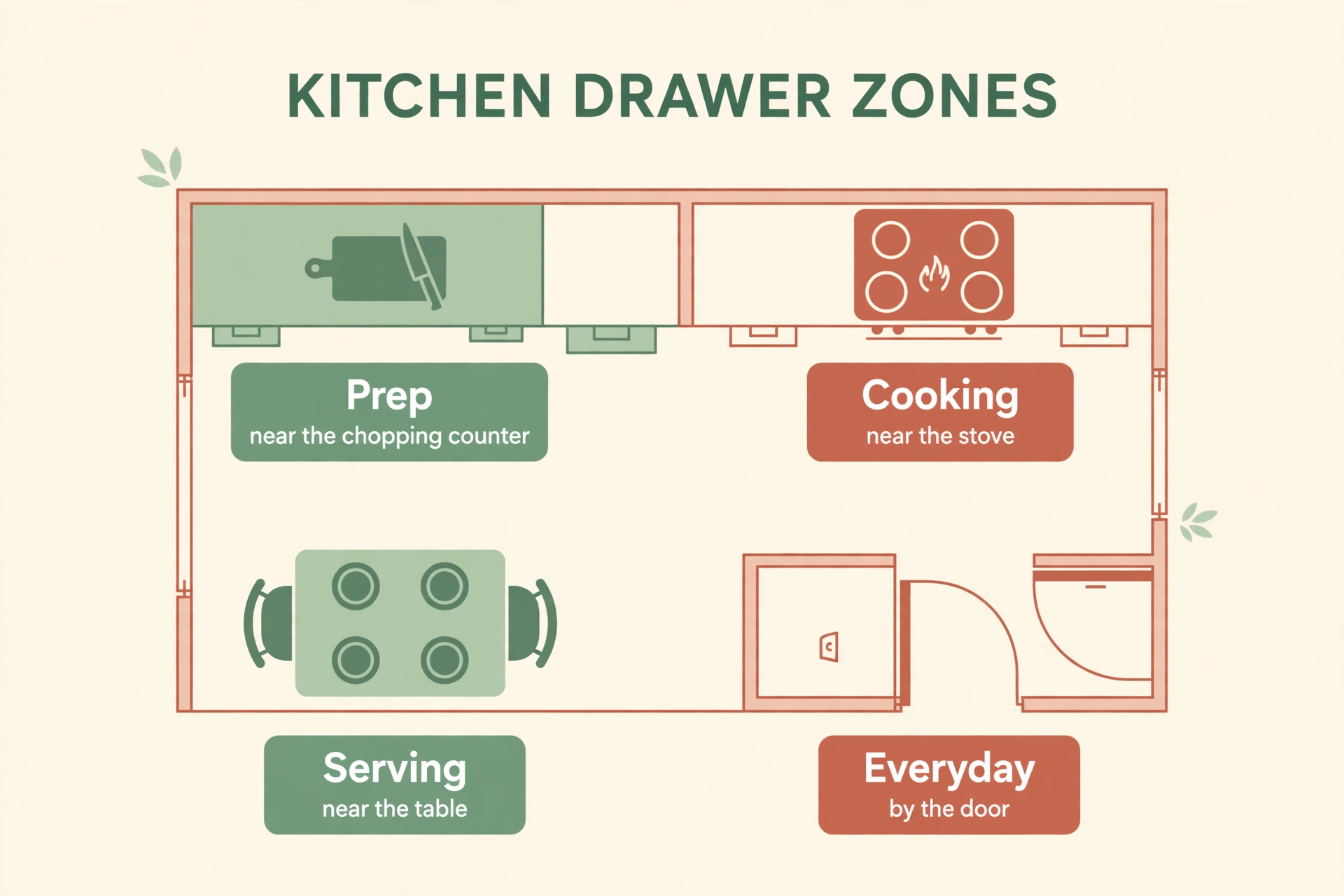
Sort by task instead. Put everything you need for prep in the drawer nearest the counter where you chop, everything for cooking near the stove, and everything for serving near the table or dishwasher. Then a meal uses one drawer at a time, not all of them at once.
That one change — task, not item — is the whole method. Everything below is just applying it, drawer by drawer.
Step 1: Do one drawer at a time
Do not empty every drawer at once. You will end up with a counter full of utensils and nowhere to put dinner down. Pick one drawer, take everything out, wipe it, and sort what came out into three piles: keep here, move to another drawer, and let go. The “let go” pile is the broken peeler, the third garlic press, the mystery tool you have never identified. Be honest here, because every item you keep has to earn its space in a drawer that is already small.
Finish that drawer completely — dividers in, items back, drawer closed — before you start the next one. Most kitchens take an afternoon, drawer by drawer, and working one at a time means the kitchen stays usable throughout.
Step 2: Name the task for each drawer
Before anything goes back, give each drawer a job. Most kitchens only need four:
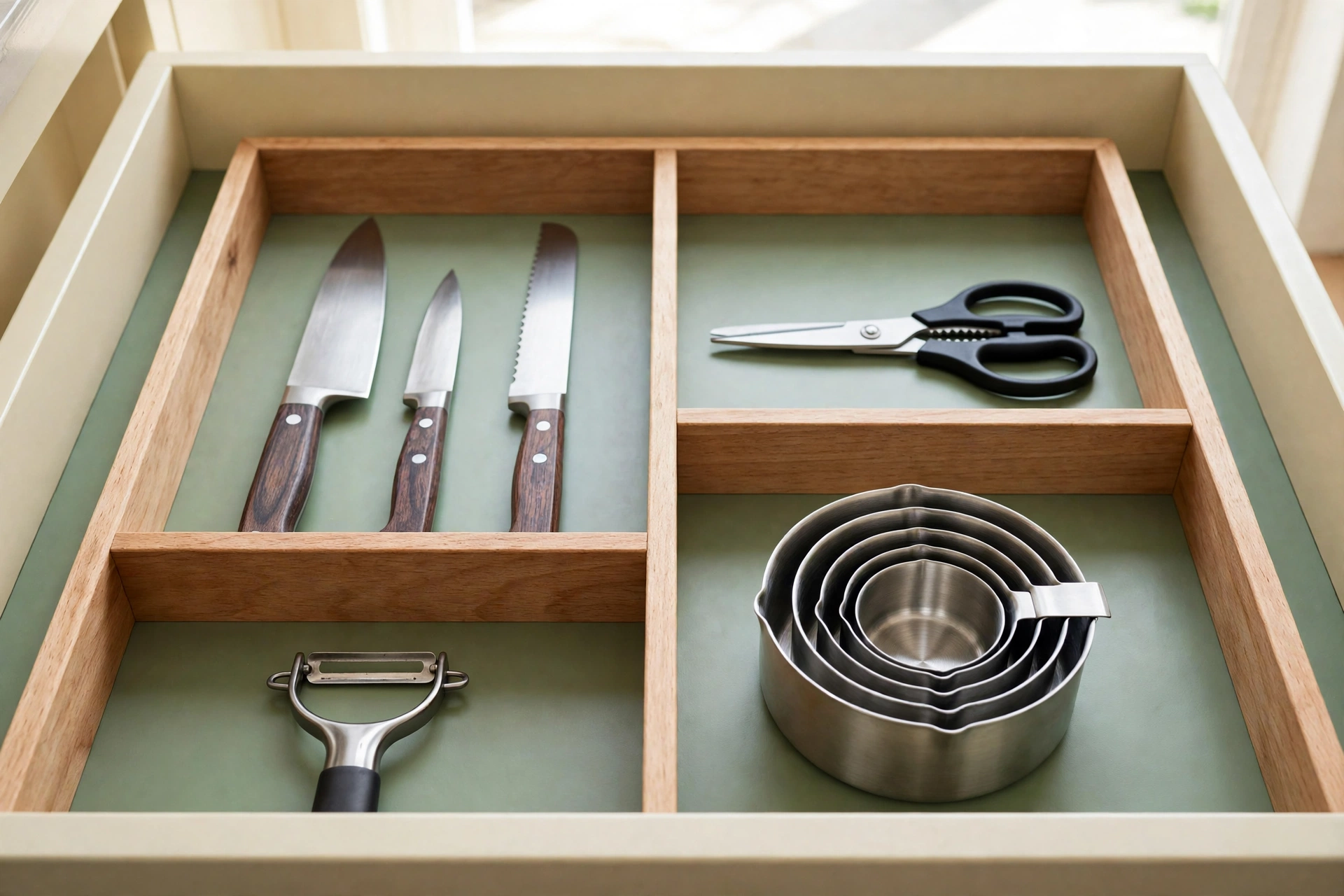
- Prep drawer — nearest the chopping counter. Knives you actually use, a peeler, a cutting board or two, measuring cups and spoons, a grater, scissors. If you reach for it while chopping, it lives here, even if it is technically a “cooking” tool.
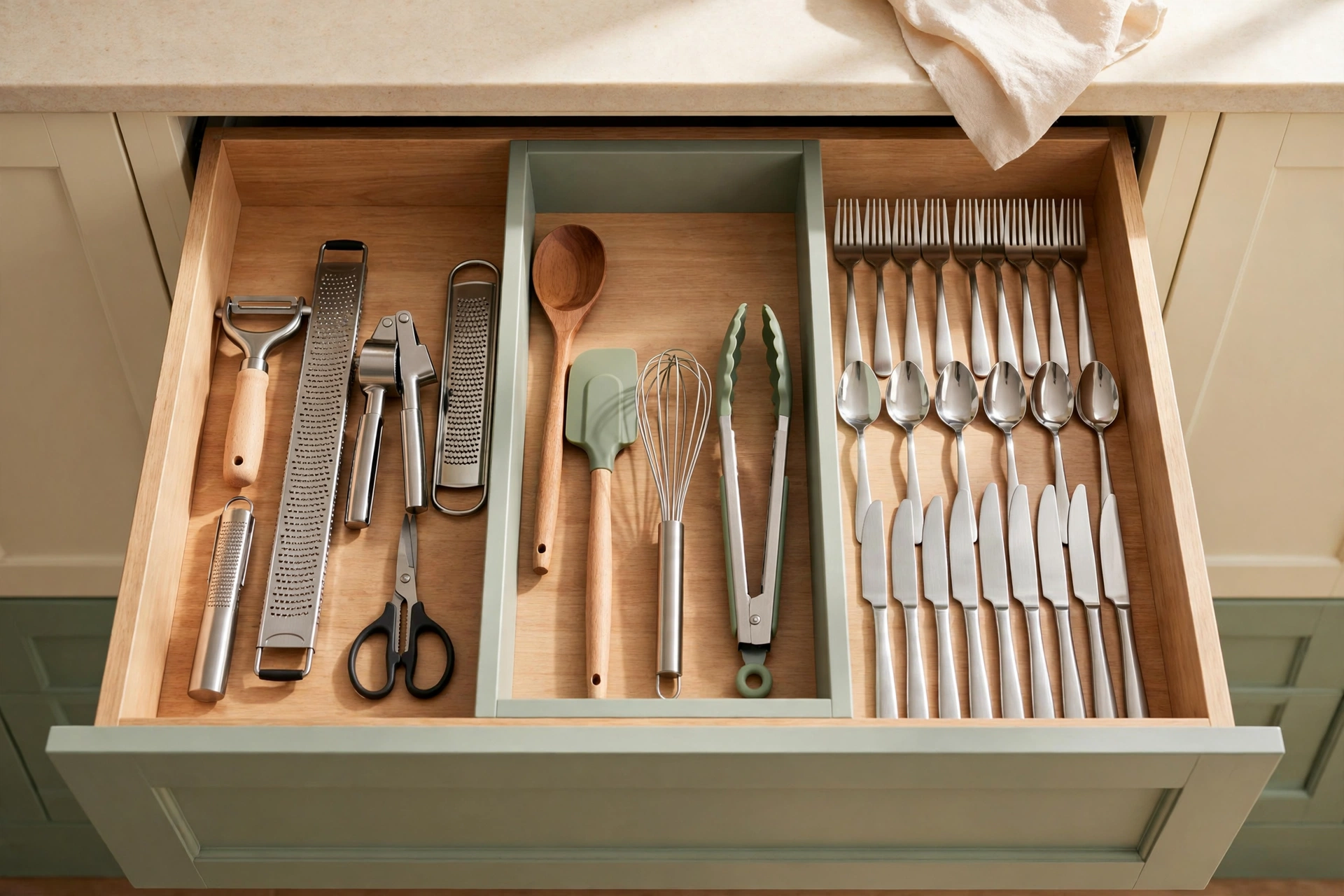
- Cooking drawer — nearest the stove. Spatulas, tongs, a ladle, wooden spoons, pot holders, a thermometer. Nothing here that you only use at the table.
- Serving drawer — nearest the table or dishwasher. Cutlery, serving spoons, napkins, placemats if they fit, the corkscrew. This is the drawer guests open, so it should be the tidiest one.
- The everyday drawer — the one by the door or the phone. This is the honest version of the junk drawer: pens, tape, scissors, batteries, a notepad, keys. Give it a real job and a divider, and it stops swallowing everything else.
If you have more drawers than tasks, the extras become overflow for the nearest task — a second prep drawer for baking tools, for example — not a dumping ground. If you have fewer drawers than tasks, combine the two closest jobs: prep and cooking together, near the stove, with a divider between them.
Step 3: Lay out dividers by task, not by size
A drawer without dividers is just a box that things slide around in. The fix does not have to be bought: a small tray, a cut-down box, even a ramekin for small items will do. What matters is the layout:
- One section per task, in the order you use them. In the prep drawer, knives first, then peelers and graters, then measuring tools. You should be able to reach in without looking and find the right section by feel.
- Heavy items at the back, light items at the front. Knives and heavy tools slide less when they sit against the back of the drawer; light items like measuring spoons stay put at the front where your hand lands first.
- Nothing loose and rolling. A single loose item — a rolling pin, a lone chopstick — will jam the drawer and scatter everything else. Give every rolling item its own section, or move it to a cabinet.
- Leave one section empty on purpose. A drawer packed edge to edge cannot be opened without things catching. One empty section, even a small one, is what lets the drawer close smoothly and stay usable.
Measure the drawer before you buy or cut anything: length, width, and depth, including how far it opens before it hits the cabinet frame. A divider that is a centimetre too long is a divider that lives in a cupboard, not in the drawer.
Step 4: Rescue the junk drawer
Every kitchen has one, and pretending it does not exist is why it grows. Rescue it instead of fighting it:
- Empty it completely and sort ruthlessly. Keep only what this household actually reaches for weekly: pens, tape, scissors, batteries, a screwdriver, a notepad. Everything else — the old keys, the expired coupons, the cable for a device nobody owns — goes.
- Give it sections like any other drawer. One section for writing, one for tools, one for batteries and small bits. A junk drawer with sections is just an everyday drawer; a junk drawer without them is a landfill.
- Set a one-in, one-out rule. When something new enters the everyday drawer, something old leaves it. That single rule is what stops the rescue from needing to happen again in three months.
If an item has no section and no weekly use, it does not belong in a kitchen drawer at all. It belongs in a cupboard, a toolbox, or the bin.
What to do with the oversized tools
Some tools will never fit a drawer sensibly: a long rolling pin, a big whisk set, a meat thermometer with a long probe, a set of long barbecue skewers. Do not force them. A drawer that will not close because of one long item is a drawer you will stop using.
Give oversized tools a different home and stop counting them as drawer items: a tall container or crock by the stove for whisks and long utensils, a cabinet hook or a narrow vertical bin for baking sheets and boards, a single deep drawer — if you have one — reserved for the long items only. The rule is simple: if an item makes a drawer jam, it does not live in a drawer. Moving one awkward item out often fixes two drawers at once, because it stops everything else from shifting every time you force the drawer shut.
Step 5: Keep it working with a two-minute reset
Drawers do not stay organized by themselves; they stay organized because the reset is short enough to actually happen. Once a week, open each drawer, push sections back into place, return anything that wandered to its task drawer, and pull out anything that crept in. Two minutes, while the kettle boils, is enough.
And when a drawer starts failing again, do not reorganize the whole kitchen. Ask one question: is something in this drawer that belongs to another task? Move that one item, and the drawer usually fixes itself.
How drawers fit the rest of the kitchen
Drawers are the small, daily half of kitchen storage; cabinets hold the bulky and the tall. If you have not set up your kitchen by zones yet, start with How to Organize a Kitchen by Zones — it decides which drawer should sit where, before you organize inside any single drawer. For a tight kitchen where every drawer counts double, How to Organize a Small Kitchen Without Adding Cabinets covers the space-saving side of the same problem.
Cabinets and drawers work as a pair: cabinets hold the bulky and the tall, drawers hold the small and the daily. See How to Organize Kitchen Cabinets So You Can Actually Reach Things.
Summary table
| Drawer task | What goes there | Where it sits |
|---|---|---|
| Prep | Knives, peeler, cutting boards, measuring cups and spoons, grater, scissors | Nearest the chopping counter |
| Cooking | Spatulas, tongs, ladle, wooden spoons, pot holders, thermometer | Nearest the stove |
| Serving | Cutlery, serving spoons, napkins, corkscrew | Nearest the table or dishwasher |
| Everyday | Pens, tape, scissors, batteries, notepad, keys | By the door or phone |
| Divider rule | One section per task, heavy at the back, one section left empty | Every drawer |
| Junk-drawer rescue | Weekly-use items only, sectioned, one-in one-out | The everyday drawer |
Frequently asked questions
How do I organize kitchen drawers without buying organizers?
Use what you already own: small trays, cut-down boxes, ramekins for small items. The layout matters more than the product — one section per task, in the order you use them, with nothing loose and rolling.
Should kitchen drawers be organized by item or by task?
By task. Sorting by item sends you to three drawers for one meal; sorting by task means prep uses the prep drawer, cooking uses the cooking drawer, and serving uses the serving drawer.
What is the best way to organize a junk drawer?
Empty it, keep only what the household reaches for weekly, give it sections like any other drawer, and set a one-in, one-out rule. A sectioned junk drawer is just an everyday drawer.
How do I stop drawers from getting messy again?
Do a two-minute weekly reset: push sections back, return wandered items to their task drawer, and move out anything that crept in. When a drawer fails, move the one item that belongs to another task.
Where should knives go in a kitchen drawer?
In the prep drawer, in their own section at the back, blades facing the same way, with nothing loose on top of them. If the drawer is shallow, a simple in-drawer knife tray keeps blades covered and fingers safe.
Alana writes about small-space and kitchen organization for LittleAdored.

One Comment