
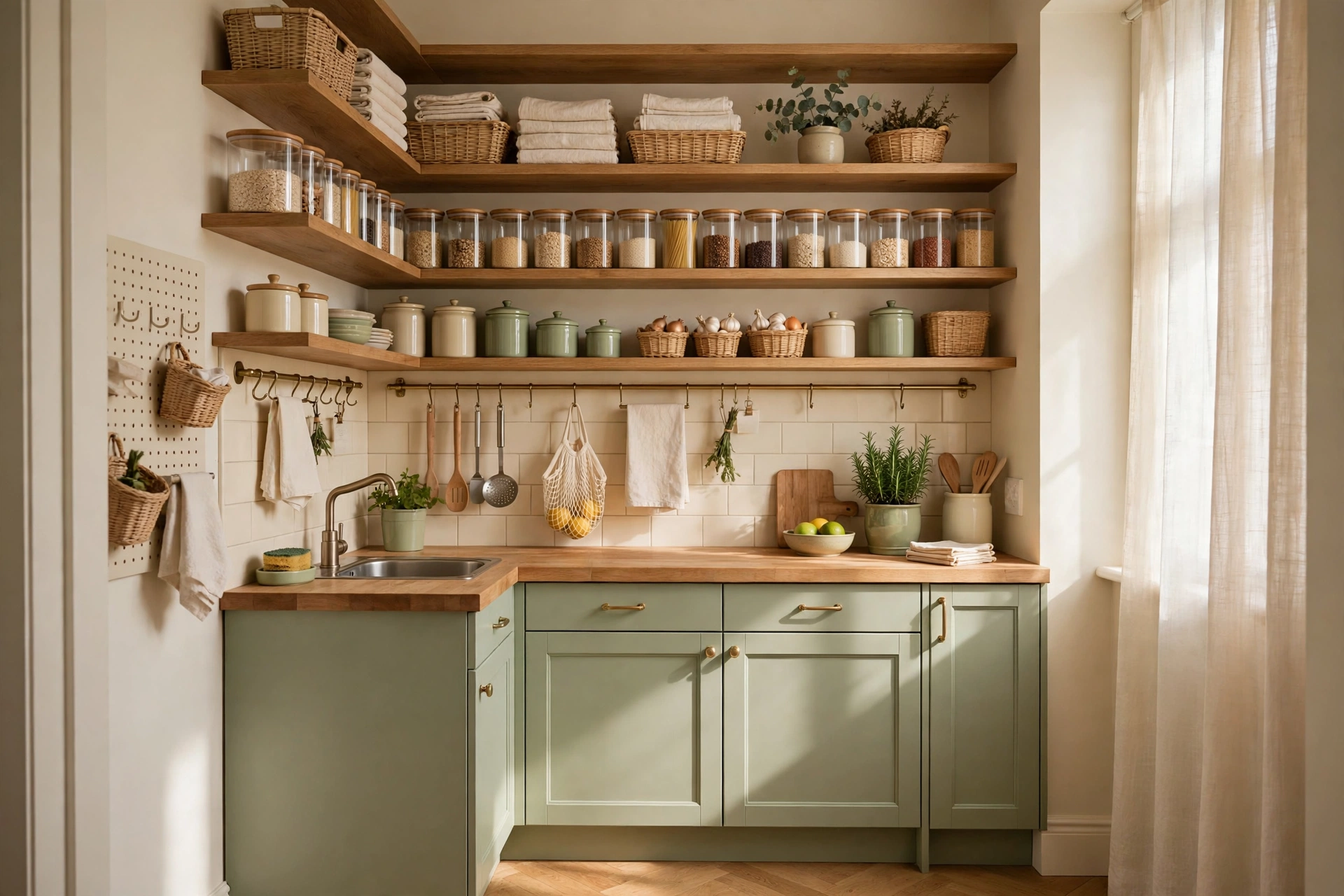
How to Organize a Small Kitchen Without Adding Cabinets
To organize a small kitchen without adding cabinets, you do not need more storage. You need a better plan for the storage you have: use your walls and the backs of your doors, shrink your kitchen into mini zones, take back your counters so they can be work space again, and keep only the tools that truly earn their place. No new cabinets, no remodel, no contractor. Just a step-by-step reset you can finish in a weekend.
Small kitchens punish clutter harder than big ones, because every inch counts double. But they also reward organizing faster: fix one shelf and you feel it at every meal. This guide walks you through the whole process, from the first declutter to the daily habit that keeps it working. If your kitchen is roomier than cozy, our guide on how to organize a kitchen by zones covers the full five-zone system for any layout.
Before Anything Else: Edit What You Own
Organizing a small kitchen starts with owning less, not storing more. Before you hang a single hook, pull everything out of one cabinet or drawer at a time and ask three questions about each item: Do I use this at least once a month? Does it do a job nothing else does? Would I buy it again today? If the answer is no, it goes in a box for donation or a new home elsewhere in the house.
Be ruthless with these space hogs:
- Duplicate tools: three spatulas, two sets of measuring cups, four wooden spoons. Keep the best one of each.
- Single-purpose gadgets: avocado slicers, banana hangers, egg separators. A good knife does most of these jobs.
- Chipped dishes and stained containers, and any lid without a matching container.
- Small appliances you rarely use. If the bread maker has been a shelf decoration for a year, it is decoration.
- Takeout extras: soy sauce packets, plastic cutlery, and paper napkins multiply in drawers. Keep a small stash and toss the rest.
You cannot organize clutter. The edit alone often frees up a full shelf, and it costs nothing.
Step 1: Take Back Your Counters
In a small kitchen, counter space is your most valuable real estate, and it is usually buried. Counters are for working, not storing. Clear everything off and put back only what you use every single day: typically the coffee maker, a knife block or strip, and a small cutting board.
Give everything else a real home:
- Move the toaster, blender, and other weekly appliances into a cabinet or onto an open shelf. Getting them out takes ten seconds; looking at them all day costs you workspace.
- Corral daily items on one tray or in one corner: cooking oil, salt, and the utensil crock. One contained cluster reads as tidy; scattered items read as mess.
- Create a single landing zone near the door for keys, mail, and bags, so they stop colonizing the prep area.
When your counters are clear, your kitchen instantly feels bigger, because the work surface is finally visible.
Step 2: Go Up: Your Walls Are Free Storage
The biggest unused storage area in most small kitchens is the wall. Cabinets stop at a certain height, but your walls keep going. A few inexpensive additions can add the equivalent of a whole cabinet:
- A wall-mounted rail with hooks for pots, pans, and utensils near the stove. Hanging your most-used pans frees an entire cabinet.
- A magnetic knife strip instead of a countertop knife block.
- One or two open shelves for everyday dishes and glasses. Keep them to things you use weekly so nothing gathers dust.
- A pegboard or a few sturdy hooks on a narrow wall for measuring cups, oven mitts, and small tools.
- A paper towel holder and a spice rack mounted under the upper cabinets, lifting them off the counter.
Mount anything heavy into studs or use proper anchors. And keep wall storage to items you reach for often; walls are for working storage, not long-term archiving.
Step 3: Claim the Hidden Spots
Small kitchens are full of storage you cannot see until you look for it: the backs of doors, the sides of cabinets, and the space under shelves. These spots are perfect for slim items:
- Stick-on or screw-in racks on the inside of cabinet doors for spices, wraps, lids, and cleaning supplies.
- A narrow rolling cart between the fridge and the counter for cans, oils, and bottles.
- Under-shelf baskets that hook onto existing shelves, instantly doubling a short shelf.
- The side of a cabinet or the fridge: a magnetic strip or a few hooks hold towels, scissors, and small tools.
- Under the sink, use stackable bins and a small tension rod to hang spray bottles, keeping the pipes accessible.
Measure before you buy anything for these spots. Hidden spaces are often oddly sized, and a rack that almost fits is a rack that wobbles.
Step 4: Shrink Your Kitchen Into Mini Zones
Zones are not just for big kitchens. In a small kitchen, each zone is simply smaller: a shelf instead of a cabinet, a corner instead of a wall. Group items by the job they do, and keep each group where the job happens:
| Zone | Lives here in a small kitchen | Keep together |
|---|---|---|
| Prep | The clearest counter, near the sink | Cutting board, knives, mixing bowl, measuring tools |
| Cooking | Shelf or cabinet nearest the stove | Most-used pan, spatula, tongs, oil, daily spices |
| Food | One shelf, a basket, or a rolling cart | Dry goods, cans, and leftover containers |
| Cleaning | Under and beside the sink | Soap, sponge, towels, trash bags |
| Serving | Shelf nearest the table or dishwasher | Everyday plates, glasses, mugs, flatware |
When everything for one job lives together, you stop crisscrossing the kitchen, which matters even more when the kitchen is tiny.
Step 5: Choose Tools That Do Double Duty
In a small kitchen, every item pays rent in space. Single-purpose tools are expensive tenants. Favor tools that handle several jobs:
- A large chef’s knife instead of five specialty knives.
- Mixing bowls that double as serving bowls.
- A Dutch oven that braises, bakes bread, and boils pasta.
- Measuring cups that nest, plus collapsible colanders and funnels.
- A toaster oven instead of a toaster plus another single-use gadget.
As a rule, if a tool does one thing and you use it less than monthly, it does not earn a spot in a small kitchen.
Step 6: Store Food Without a Pantry
No pantry is no problem if you treat food storage as its own mini zone. Decant dry goods like flour, rice, and pasta into clear, square containers: they stack neatly, you can see what is inside, and square shapes waste less shelf space than round bags.
Then give food a defined home:
- One shelf or one basket per category: breakfast, baking, snacks, cans. When the basket is full, something gets used before anything new comes in.
- Use the fridge doors for condiments and jars, and keep a small turntable for deep shelves so nothing hides in the back.
- Store potatoes, onions, and garlic in a ventilated basket in a cool corner, not scattered across the counter.
- Keep a short shopping list on the fridge and buy smaller quantities more often. Less stockpiled food means less storage needed.
Small-Kitchen Summary Map (At a Glance)
Pin this map on the fridge while you reset. Each row pairs a common small-kitchen problem with its fix:
| Challenge | Fix | Where |
|---|---|---|
| No counter space | Store weekly appliances off the counter | Cabinet or open shelf |
| No cabinet space | Go vertical | Wall rails, hooks, open shelves |
| Wasted door space | Use the backs of doors | Racks for spices, lids, wraps |
| Scattered tools | Shrink into mini zones | One shelf or corner per job |
| Too many gadgets | Keep double-duty tools only | Donate the unitaskers |
| No pantry | One basket or shelf per food category | Clear, square containers |
The Five-Minute Habit That Keeps It Working
A small kitchen stays organized with one tiny routine: a five-minute reset every night. Dishes go in the dishwasher or on the drying rack, counters get wiped, and anything that wandered goes back to its zone. Five minutes is enough, because in a small kitchen there is simply less to put away.
Add one rule that protects the whole system: one in, one out. Every new kitchen item that enters means an old one leaves. That single rule stops clutter from quietly rebuilding.
Frequently Asked Questions
How do you maximize storage in a very small kitchen?
Use vertical space and hidden spots first: wall rails, hooks, magnetic strips, the insides of cabinet doors, and under-shelf baskets. Then edit ruthlessly, because no storage trick beats owning less. Most very small kitchens gain the equivalent of a full cabinet from these two moves alone.
How do I organize a small kitchen with no pantry?
Give food its own mini zone: one shelf or rolling cart with clear, square containers grouped by category, like breakfast, baking, and snacks. Store potatoes and onions in a ventilated basket in a cool corner, and buy smaller quantities more often so you stockpile less.
What should I get rid of in a small kitchen?
Duplicates, single-purpose gadgets, chipped dishes, lids without containers, appliances you use less than monthly, and the drawer full of takeout extras. If you would not buy it again today, let it go.
How do I keep small kitchen counters clear?
Keep only daily-use items on the counter, corral them on one tray or in one corner, and give everything else a real home in a cabinet, on a wall, or on a shelf. A nightly five-minute reset keeps counters from slowly refilling.
Can I organize a small kitchen without buying anything?
Yes. The edit costs nothing and often frees a full shelf. Rearranging into mini zones, clearing counters, and moving items to the backs of doors are all free. Only add hooks or shelves after living with the new layout for a week, so you buy exactly what you need.
Your Next Step
Pick the step that bugs you most and do it today: clear one counter, empty one junk drawer, or hang one rail of hooks. Small kitchens change fast, and you will feel the first win by dinner. When you are ready to fine-tune every area, read our guide on how to organize a kitchen by zones for the complete five-zone system behind this method.

One Comment