
How to Organize Cleaning Supplies Under the Sink
The cabinet under the kitchen sink collects cleaning supplies the way a junk drawer collects batteries: one bottle at a time, until you cannot find the one you need and you buy a second of the one you already own. The problem is rarely the number of bottles. It is that daily, weekly and rarely-used supplies all share the same floor, with nothing telling you which is which. Organize them by job and by how often you use them, and the cabinet stops being a pile and starts working like a small cleaning station.
Start with the same two rules that govern everything under the sink: measure the space and the pipes first, and never block the shut-off valves. Everything else in this guide follows from those.
Step 1: Take everything out and sort by job, not by bottle size
Empty the cabinet completely and wipe the floor dry. Then sort what came out into groups by job: kitchen surfaces, bathroom cleaning, floors, laundry, and dish care. A bottle’s job matters more than its shape — the all-purpose spray and the kitchen cloth belong together even if one is tall and one is flat, while two tall bottles for different rooms do not belong together at all.
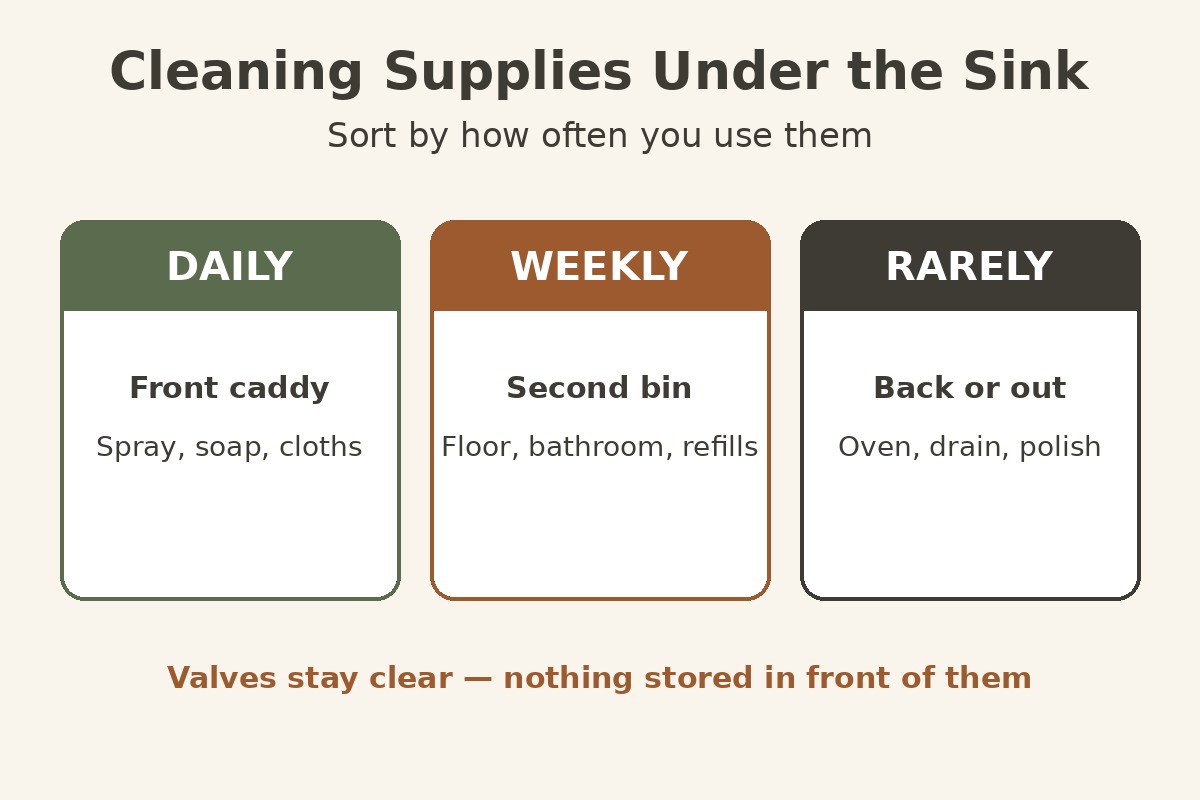
Inside each job group, split again by frequency. Daily supplies are the ones you reach for almost every day: the all-purpose spray, the dish soap, a cloth or two, the sponge. Weekly supplies are the floor cleaner, the bathroom spray, the scrub brush, the refills. Rarely-used supplies are the oven cleaner, the drain product, the special polish you use a few times a year. Daily earns the front, weekly earns a back bin, rarely-used earns the highest or deepest corner — or a different cupboard entirely, if the cabinet is small.
While you sort, let go of the obvious dead weight: empty bottles, duplicates of the same cleaner, products for appliances you no longer own, and anything past its best. A cabinet organized around products nobody uses is still a cluttered cabinet.
Step 2: Give daily supplies one caddy at the front
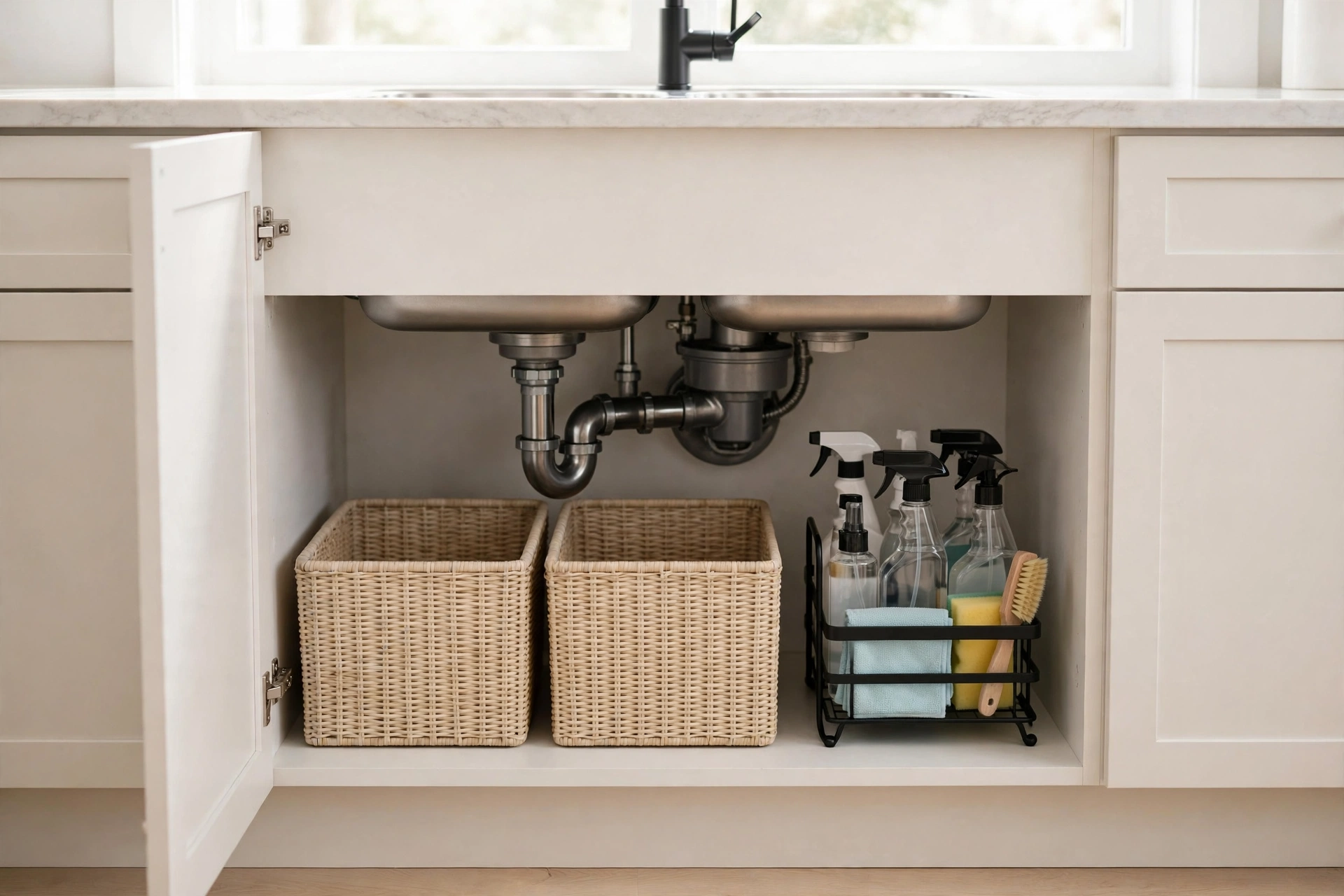
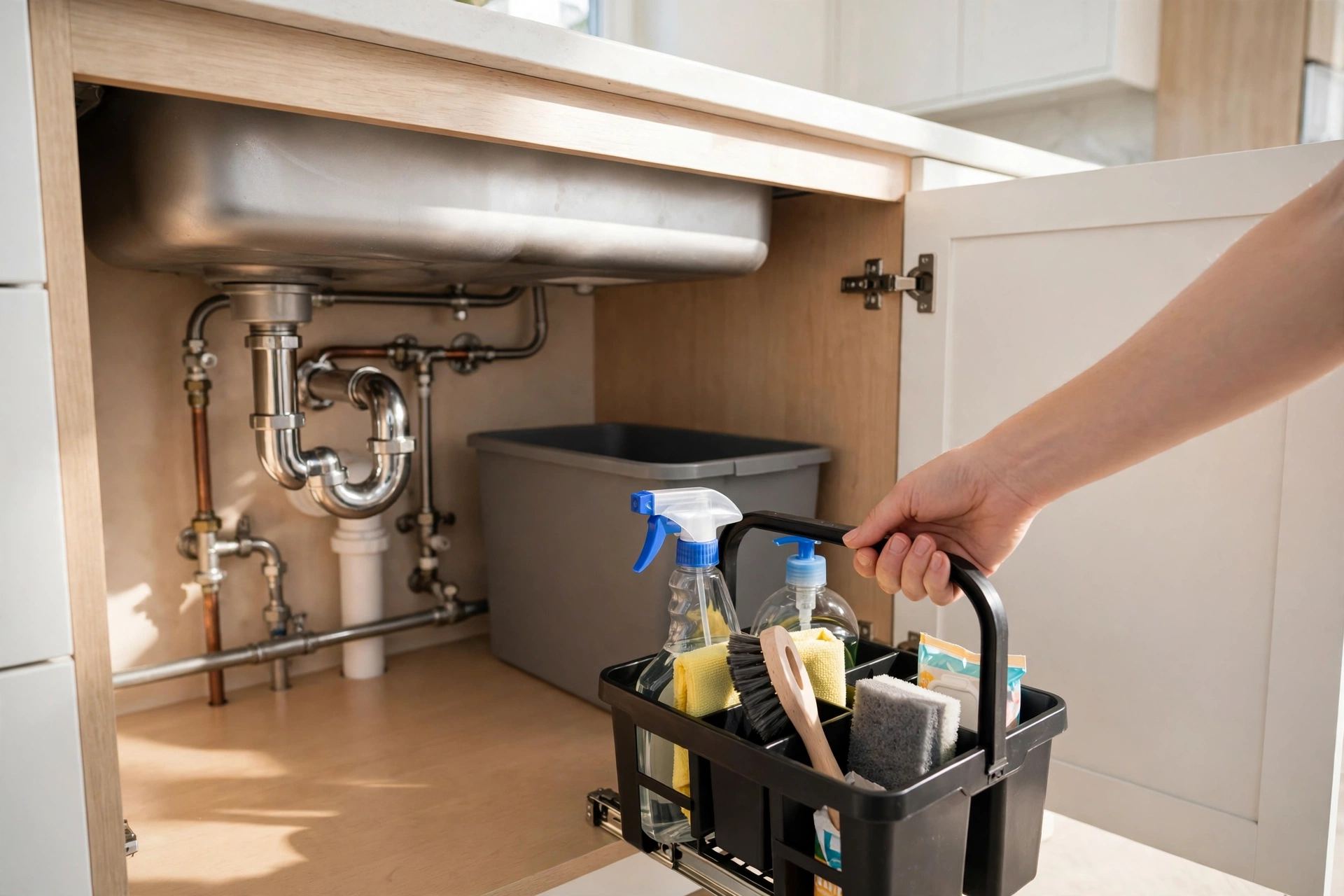
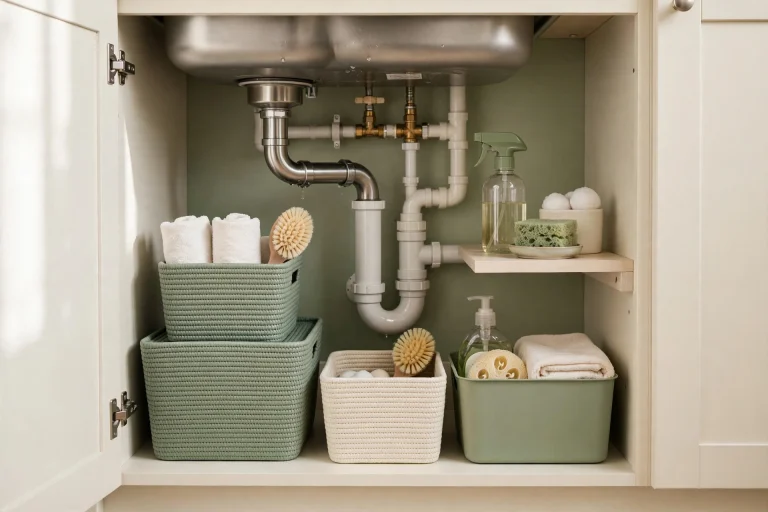
Daily supplies belong in one open caddy or low bin at the front of the cabinet, where your hand finds it without crouching and reaching past the pipes. The caddy should hold only the daily group: all-purpose spray, dish soap, cloths, sponge. When the caddy slides out, you have the whole daily kit in one move; when it slides back, the cabinet looks tidy again.
Keep the caddy shallow enough to see into and light enough to lift with one hand. If it is too deep, small items sink to the bottom and disappear; if it is too heavy, it stops being a caddy and becomes another obstacle. Label it “Daily” if anyone else in the house uses the cabinet — a label is what keeps the weekly bottles from migrating into it.
Step 3: Put weekly supplies in a second, labelled bin behind it
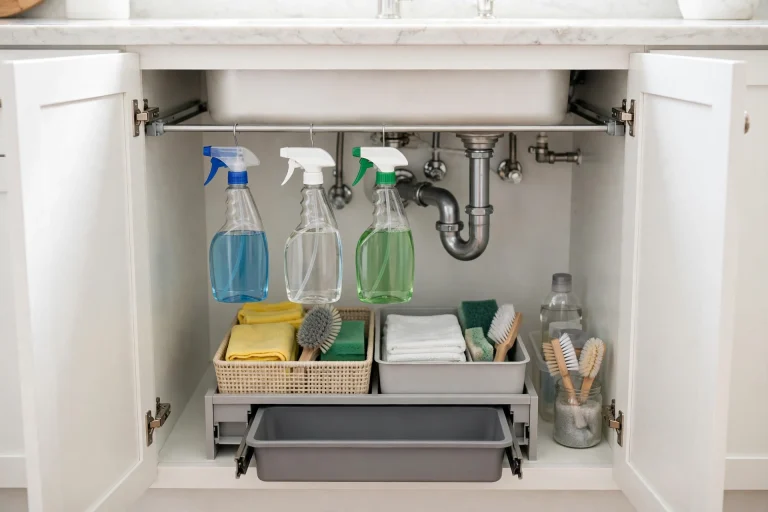
Weekly supplies get their own bin, behind or beside the daily caddy, never mixed into it. Floor cleaner, bathroom spray, scrub brushes and refills live here, one bin per job if the cabinet is wide enough, or one “Weekly” bin if it is not. The point is the boundary: when the weekly bin is separate, you never have to move five weekly bottles to reach the daily spray, and you never buy a duplicate because the weekly bottle was hiding behind the daily one.
Leave a finger-width of space on each side of each bin so they slide freely, and keep both bins off the pipes themselves. Bins sit on the cabinet floor beside or in front of the pipes, never resting on them, so a plumber — or you, in a hurry — can reach the pipes without dismantling your storage.
Step 4: Move rarely-used supplies up, back, or out
Rarely-used supplies are the ones that quietly wreck an under-sink system, because they sit untouched for months and block the supplies you actually use. Give them the least convenient spot in the cabinet — the back corner, or a high shelf if the cabinet has one — or move them out entirely to a utility cupboard or laundry shelf. A product you use twice a year does not earn front-of-cabinet space, however neatly it is labelled.
If a rarely-used product is also bulky or heavy, it definitely leaves the under-sink cabinet. Heavy bottles on a high shelf are hard to lift out safely, and anything stored above the pipes risks a drip going unnoticed. Keep the under-sink cabinet for cleaning supplies you genuinely use in the kitchen, and let the rest live where its weight and size are not a problem.
Step 5: Keep the valves clear and the floor dry
Whatever system you build, three things stay non-negotiable. The shut-off valves stay reachable at all times, with nothing stored in front of them. Nothing absorbent sits loose on the cabinet floor, where a slow drip turns it into a damp, forgotten mess. And the trap and pipes stay unblocked, so a leak is spotted quickly instead of soaking into a pile of bottles.
Once a month, pull both bins out, check for leaks or damp spots, and return anything that wandered to its own bin. Five minutes is enough, and it is the check that catches a slow leak before it damages the cabinet floor — and the check that stops a duplicate bottle from creeping back in.
How this fits the rest of the kitchen
This guide is the supplies half of the under-sink story. For the full method — working around the pipes, setting use-first zones, and choosing bins by shape — start with How to Organize Under the Kitchen Sink Around Pipes. For the hanging and door-storage half, Under-Sink Organization: Tension Rods, Pull-Out Bins and Door Storage adds the rod and door layers on top of the bins here. And for the routine that keeps the whole kitchen in the same shape, How to Keep a Kitchen Organized: A Weekly 15-Minute Reset Routine covers the weekly pass that keeps bins from drifting.
Summary table
| Group | Where it lives | Watch out for |
|---|---|---|
| Daily | One open caddy at the front | Only daily items — weekly bottles migrate in if unlabelled |
| Weekly | Second labelled bin behind or beside the daily caddy | One job per bin where space allows; mixed bins fail |
| Rarely-used | Back corner, high shelf, or a different cupboard | Bulky or heavy items leave the cabinet entirely |
| Valves and pipes | Always reachable, always clear | Nothing stored in front of the valves; nothing resting on pipes |
| Cabinet floor | Bins only, nothing loose | No absorbent items loose on the floor |
Frequently asked questions
How many cleaning products should live under the sink?
As few as the jobs you actually do in the kitchen: a daily group of three or four items and a weekly group of a similar size. If the cabinet holds more than two bins’ worth, something in it belongs elsewhere — usually a rarely-used or duplicate product.
Should cleaning supplies be kept away from food?
Yes, in the sense that they should never share a bin or shelf with food, and bottles should stay upright with caps closed. Under the sink is a cleaning zone, not a pantry overflow; food that migrates there gets forgotten and, worse, confused with a cleaner.
What if my under-sink cabinet is too small for two bins?
Use one daily caddy at the front and move the weekly supplies to the nearest alternative — a laundry shelf, a utility cupboard, or the cleaning closet. One working bin beats two bins squeezed so tight neither slides.
How do I stop bottles leaking onto the cabinet floor?
Keep bottles upright, caps tight, and bins shallow enough that a leak is visible at a glance. The monthly pull-out check catches the slow drip that a crowded, never-emptied cabinet hides for months.
Can I store cloths and sponges under the sink?
Daily cloths and the sponge, yes, in the daily caddy where they dry between uses and are seen every day. A pile of damp cloths loose on the cabinet floor, no — that is where smells and damp start.
Shop This Guide’s List
Prefer to shop it all in one place? Every product in this guide is collected in our Benable list: Cleaning Supplies Under the Sink: The Small-Space System That Ends the Bottle Pile — tap any item to see it at the store.

One Comment