
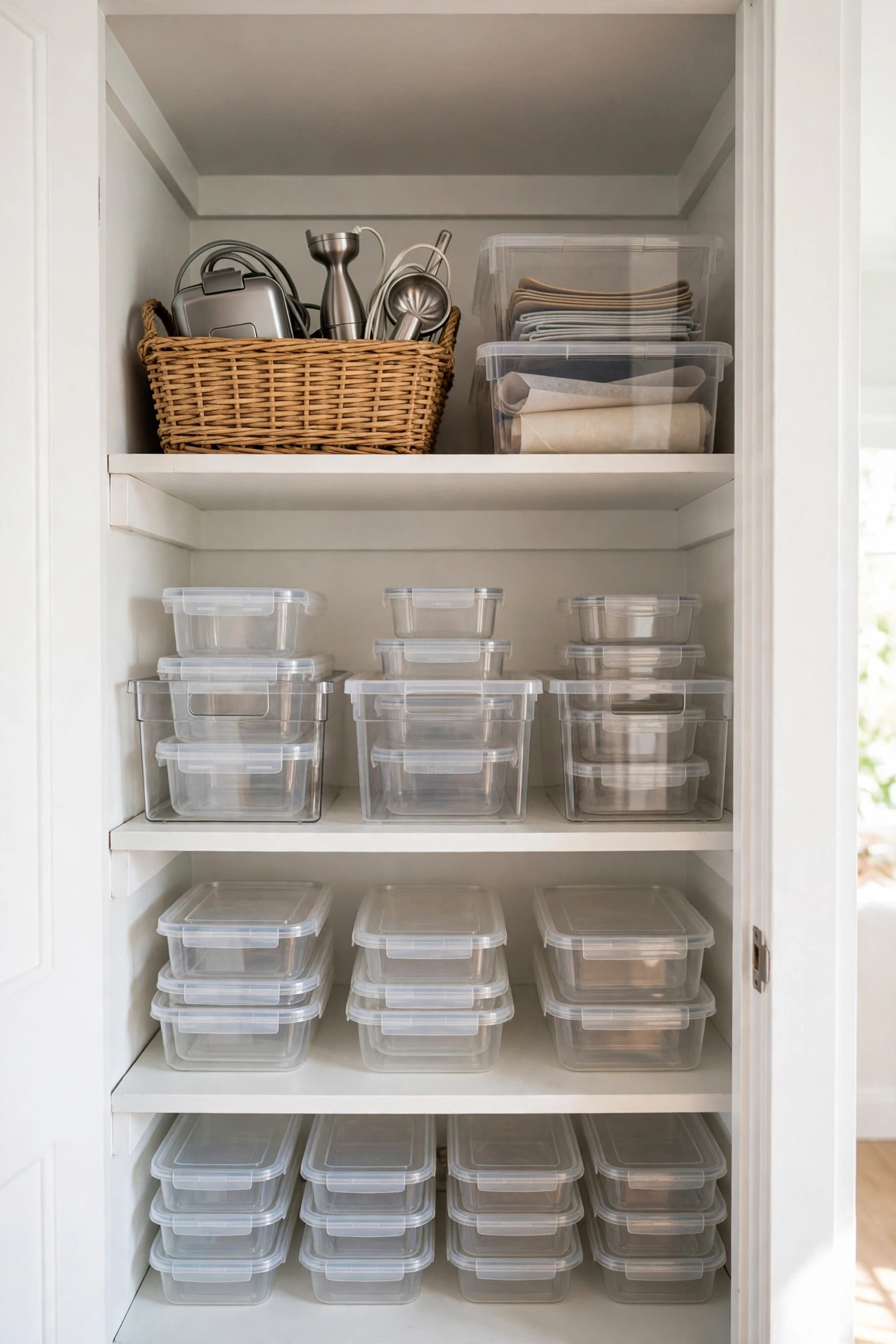
How to Organize a Small Closet for Kitchen Overflow
Every organized kitchen has a pressure valve: the things that do not fit in the kitchen itself — the spare appliance, the bulk buy, the serving dishes used twice a year. Without a plan, those things land in the nearest closet and the closet becomes a second junk drawer, one you cannot see into. With a plan, a small closet holds the overflow and stays usable.
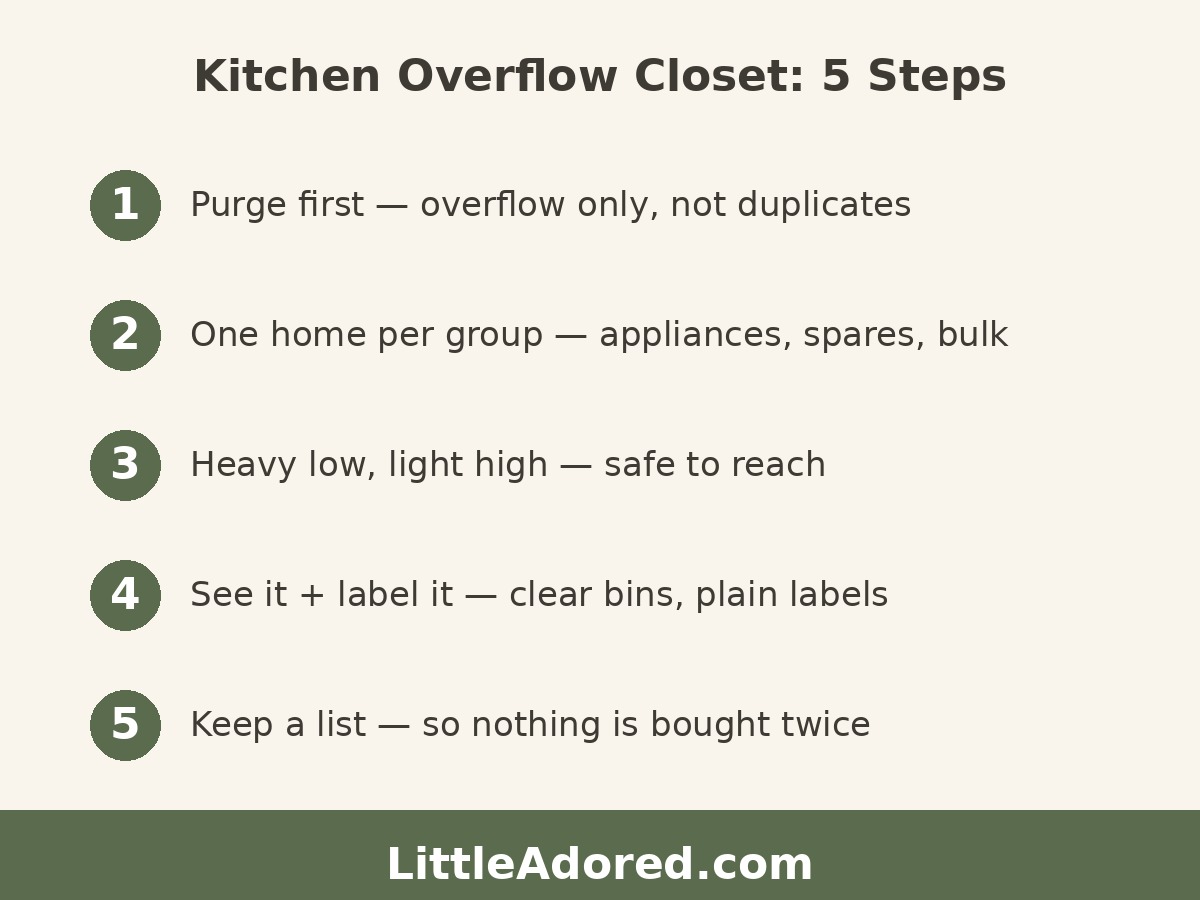
Start with the answer in one sentence: a kitchen overflow closet works when it holds only true overflow, when each group has exactly one home, when heavy things sit low, and when a short list on the door tells you what is inside without opening every bin.
Step 1: Purge first — overflow only, not duplicates
Empty the closet completely before anything goes back. Sort what comes out into three piles: belongs in the kitchen (put it back there now, or admit the kitchen has no room for it), true overflow (used, but rarely, or bought in bulk), and does not belong anywhere (broken, duplicated, or never used — let it go).
The purge matters because overflow closets fail by accumulation. A duplicate appliance, a gadget bought twice because the first was forgotten in the closet, a box kept “just in case” for three years — each one takes the space a real overflow item needs. How to Declutter a Kitchen Before You Organize It uses the same keep / move elsewhere / let go test, and it applies here word for word: if it has not been used in a year and has no seasonal job, it is not overflow, it is clutter.
Step 2: One home per group
Group what remains by use, not by size: rarely used appliances together, spare containers and lids together, bulk pantry spares together, seasonal serving pieces together. Each group gets one bin or one shelf section — never two, because a group split across two places is a group you cannot find.
This is the same zone idea the kitchen itself runs on. How to Organize a Kitchen by Zones (Prep, Cooking, Cleaning, Storage) divides the kitchen by job; the closet divides by the same logic, one step removed. When you need the spare slow cooker, you go to the appliance group, not to three different shelves.
Step 3: Heavy low, light high
Put heavy items — the spare mixer, the stack of baking dishes, the bulk rice — on the lowest shelf or the floor of the closet, where they can be lifted safely and where they cannot fall on anyone. Light, bulky things — spare linens, empty baskets, seasonal decorations for the table — go high.
Reach matters as much as weight. The group you reach for most often among the overflow (usually bulk pantry spares) sits at eye or waist height; the group you touch twice a year (holiday serving pieces) can sit at the very top. A closet that requires a step stool for a weekly item is a closet that will stop being used.
Step 4: See it and label it
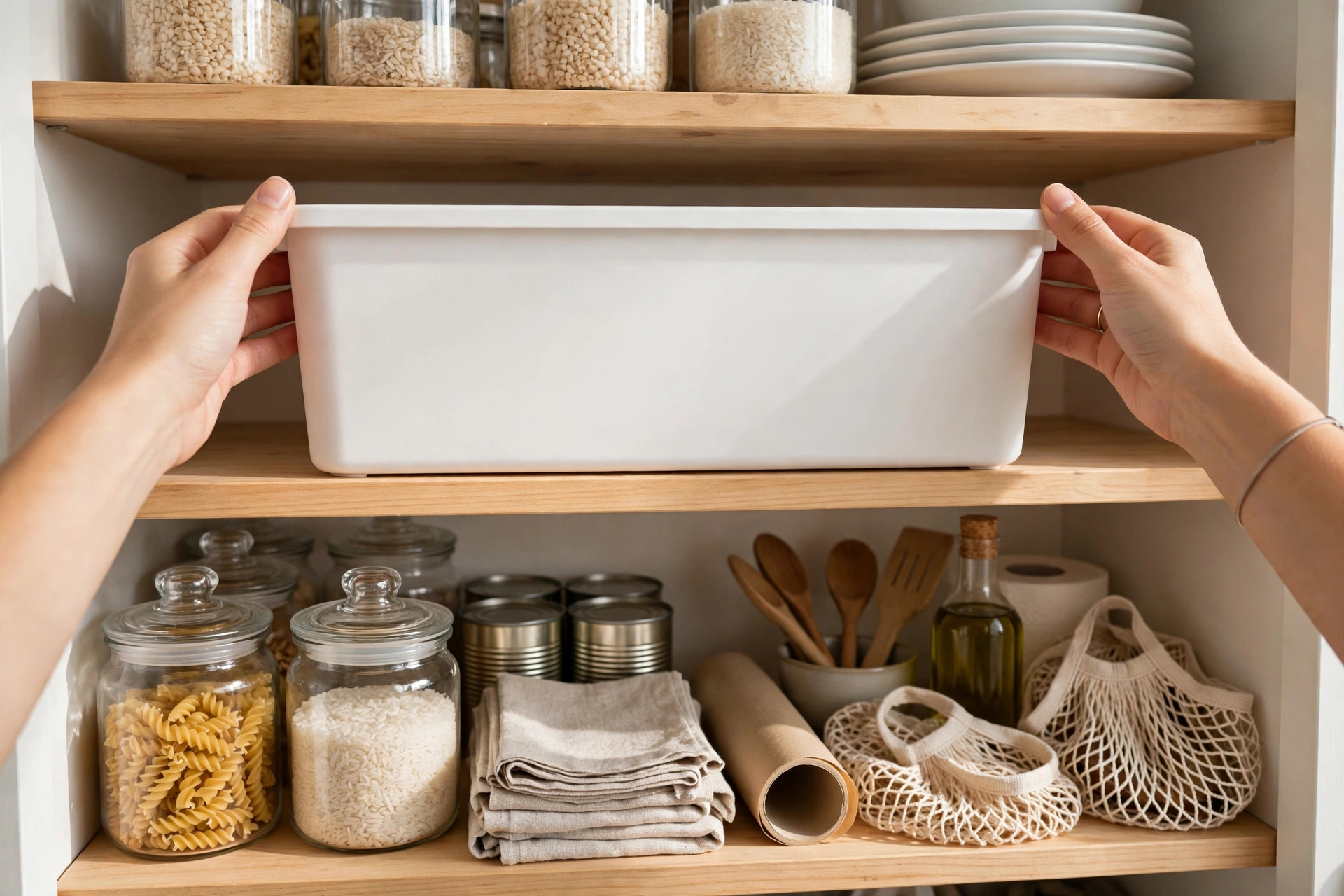
Use clear bins where you can, so the group inside is visible without opening the bin, and label every bin in plain words — “Spare appliances”, “Bulk pantry”, “Serving dishes” — not codes or categories only you understand. A label that needs explaining is not a label.
Keep one list on the inside of the closet door, in the same plain words, with one line per group and its shelf. The list is what stops the duplicate purchase: before buying another set of containers, check the list. How to Organize a Small Apartment Kitchen in 7 Steps (Renter-Friendly) makes the same point for small kitchens — what you cannot see, you buy twice.
Step 5: Keep the closet on the reset
An overflow closet drifts like every other storage: things get shoved in front, groups migrate, the list goes stale. Fold it into the weekly routine: How to Keep a Kitchen Organized: A Weekly 15-Minute Reset Routine already rotates one drawer and one cabinet a week — add the overflow closet to that rotation once a month, so it gets emptied, wiped, and re-listed before it becomes a project.
If the closet is full again within a month, that is information, not failure: either something in it is not true overflow, or the kitchen itself needs a declutter pass first. Do not buy a bigger closet’s worth of bins to solve a purge problem.
What does not belong in the overflow closet
Food that needs the pantry’s conditions, anything that will spoil in heat or damp, cleaning chemicals stored above food items, and anything borrowed or broken that is waiting for a decision. Decisions do not live in closets — they live on calendars. If an item’s only reason for being there is that nobody decided what to do with it, decide now.
Summary table
| Step | What to do | Why it works |
|---|---|---|
| Purge first | Empty, sort keep / overflow / let go | Stops duplicates taking real space |
| One home per group | Appliances, spares, bulk, seasonal — one place each | Findable without hunting |
| Heavy low, light high | Heavy on the floor or lowest shelf | Safe to lift, nothing falls |
| See it + label it | Clear bins, plain labels, door list | No duplicate buying |
| Monthly reset | Fold into the one-drawer-one-cabinet rotation | Drift caught before it becomes a project |
Frequently asked questions
What counts as kitchen overflow?
Things you use and keep, but not often enough to earn kitchen space: rarely used appliances, bulk pantry spares, seasonal serving pieces, and spare containers. If it is used weekly, it belongs in the kitchen, not the closet.
Should overflow go in clear bins or closed boxes?
Clear bins where possible, because seeing the group stops you opening every bin to find one thing. Closed boxes are fine for light, bulky items up top, as long as the label says exactly what is inside.
How do I stop the closet filling up again?
One home per group, a door list, and a monthly reset in the existing rotation. If it fills within a month, purge again — the problem is what went in, not the size of the closet.
Can a hall closet work if there is no pantry?
Yes — it becomes the pantry’s overflow, not its replacement. Daily food stays in the kitchen; the closet holds spares and bulk. How to Organize a Kitchen With No Pantry sets out the zone system for a kitchen with no pantry cupboard.
What if the closet is tiny?
Then the purge matters more, not less. A tiny closet holds one or two groups well and everything badly — pick the groups that genuinely need it, and let the rest go.
Shop this guide’s list
Shop the matching list on Benable — Kitchen Overflow Storage That Actually Fits in a Small Closet: https://benable.com/LittleAdored/kitchen-overflow-storage-that-actually-fits-in-a-small-closet

One Comment